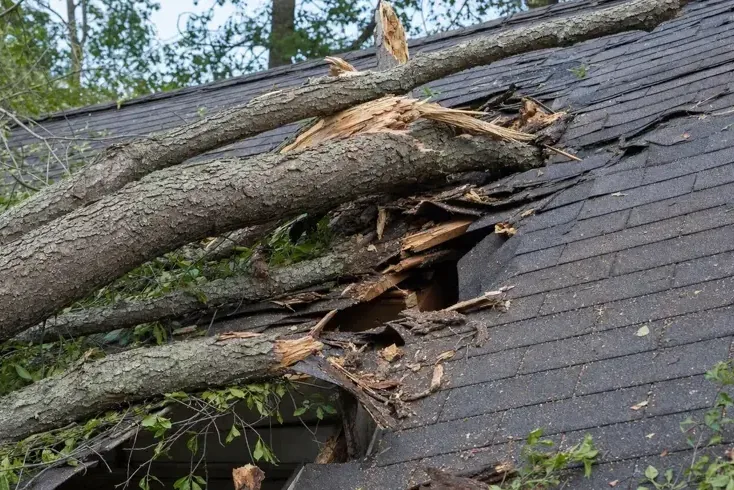
Brea summers are dry and hot, then winter storms and atmospheric rivers drop heavy rain in short bursts. The first of those storms is the one that finds every gap a dry season left behind.
Key takeaways
- Dry summers shrink sealants and loosen flashing, and the first heavy rain finds the gaps.
- Common entry points are flashing around vents and chimneys, roof valleys, cracked or slipped tiles and worn shingles.
- A ceiling that bulges with water is a hazard, so people stay clear and let a professional release it.
- Wet attic insulation and ceiling drywall usually come out, while framing is dried in place.
- A roof inspection after the storm matters as much as the indoor drying.
Why the first storm finds the weak spots
Months of hot, dry weather leave their mark on a roof. Sealants dry out and crack, flashing lifts at the edges, and dust and debris pile up in valleys and gutters.
When the rain finally comes in a heavy burst, water that would have run off a healthy roof gets pushed into every opening.
Local storms are short and intense. Water has little time to dry out between waves, so a small gap lets in a lot.
Roof tile can shift slightly as it expands and contracts with heat, and composition shingles lose flexibility as they age. Neither problem shows from the ground.
- Sealant shrinks and cracks
- Flashing lifts at the edges
- Debris gathers in valleys and gutters
- Tiles shift slightly with heat
- Rubber collars around vent pipes dry out and split
Where water gets in
Brea has tile roofs and composition roofs, and each fails in its own way. Some entry points are shared by both.
A leak rarely shows up directly under the opening. Water enters at the roof, runs along rafters or across the top of the ceiling, and drops through at a seam or a light fixture several feet away.
- Flashing around plumbing vents, skylights and chimneys
- Valleys where two roof slopes meet
- Cracked, slipped or missing tiles
- Worn composition shingles with exposed nails
- Gutters and downspouts clogged with summer debris
What to do while it is still raining
The immediate job is to limit what the water can reach. Nobody should climb on a wet roof, so the work happens inside.
If water has already pooled on a floor, water extraction removes it before it soaks into carpet and wall bottoms.
Moving the bucket as the drip moves keeps the stain from spreading, and a towel under it stops splashing. Small steps like that keep the loss small until the roofer arrives.
- Put a bucket or a tub under the drip and move furniture and rugs clear.
- Cover what cannot move with plastic sheeting.
- Keep away from a ceiling that bulges or sags, since it holds a lot of water.
- Do not use light fixtures or switches under a wet spot.
- Photograph the stain, the drip and the time it started.
Water in the attic and the ceiling below
In the attic
Attic insulation acts like a sponge. Once it is wet it sags, loses its value and holds water against the framing and the ceiling beneath it.
Wet insulation also hides leaks. It can hold water and release it slowly, so a ceiling may keep staining after the rain stops.
In the ceiling
Ceiling drywall softens, stains and eventually sags. A ceiling that bulges can fail without warning, which is why only a trained crew should release trapped water.
The ceiling leak water damage work removes the softened section, opens the cavity and dries it before new drywall goes up.
How the drying team handles a roof leak
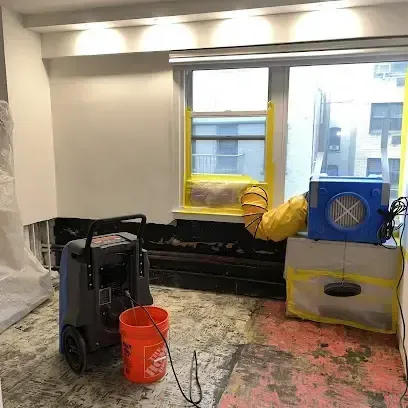
A roof leak water damage job splits in two. A roofer fixes the roof, and the drying team handles everything the water touched.
The team starts with moisture readings in the ceiling, the walls below it and the attic. Thermal imaging then traces how far the water traveled.
Soaked insulation and wet drywall are removed. Framing that can be saved is dried with air movers and dehumidifiers, which also lowers the chance that mold gets started.
Ceiling lights and fans in the wet zone are switched off at the panel and checked before anyone uses them again, since water can sit inside the housing.
- Moisture meters check the ceiling, walls and attic framing.
- Wet insulation is removed and bagged.
- Softened drywall is cut out and the cavity is opened.
- Equipment runs until readings match a dry reference.
After the storm: what to check on the roof
Once the rain stops and the roof is dry, a roofer can find the exact entry point. Fixing the cause matters, since the same spot will leak again in the next storm.
If water also came in at a garage door or a low doorway, the storm and flood cleanup crew handles that side of the loss.
A roofer can put a temporary cover over an opening until a full repair is possible, which keeps the next shower out while the drying finishes.
Planning ahead helps. A roofer's check in early fall is far easier than an emergency repair in the middle of a storm.
- Ask the roofer to check flashing, valleys and vents first.
- Clear gutters and downspouts before the next system arrives.
- Look for stains on ceilings and wall tops after each storm.
- Keep dated photos so changes between storms are easy to see.
Roof leak, plumbing leak or AC leak: how to tell
A roofer fixes a roof leak, a plumber fixes a plumbing leak and a technician fixes an AC drain. Guessing wrong means paying for the wrong repair while the water keeps coming.
Signs it is the roof
- The stain appears or grows during or right after rain.
- The stain sits near an exterior wall, a vent, a skylight or a chimney.
- Brown rings spread outward after each storm.
Signs it is something else
- The stain appears in dry weather.
- It sits under a bathroom, a kitchen or a laundry room.
- It is under the attic air handler and shows up on hot days.
Questions
Why does a roof leak more after a dry spell?
Sealants dry and crack and flashing lifts at the edges, so the first heavy rain finds gaps that were not wet for months.
Should I climb up and tarp the roof myself?
No. A wet roof is slippery and dangerous. Limit the damage from inside and have a roofer handle the roof once conditions are safe.
What do I do about a bulging ceiling?
Stay away from it and keep others clear. It is holding water and can fail without warning, so a trained crew should release it.
Does the insulation in the attic have to be replaced?
Usually, if it is soaked. Wet insulation stops insulating and keeps water against the framing and ceiling.
Can the ceiling be dried instead of replaced?
Sometimes. Drywall that stayed wet a short time and still feels firm can often be dried, while drywall that is soft or sagging is cut out.
Is it safe to wait if the stain stops growing?
A stain that stops growing does not mean the structure is dry. Insulation and framing can stay wet above it, so a moisture reading is the only reliable check.