Structural Drying in Villa Park, CA
After the water is out, the structure still holds moisture. Air movers, dehumidifiers and cavity injection pull it from framing, flooring and drywall, and daily readings decide when the equipment can leave.
(888) 563-9619Ask how long your house needs to dry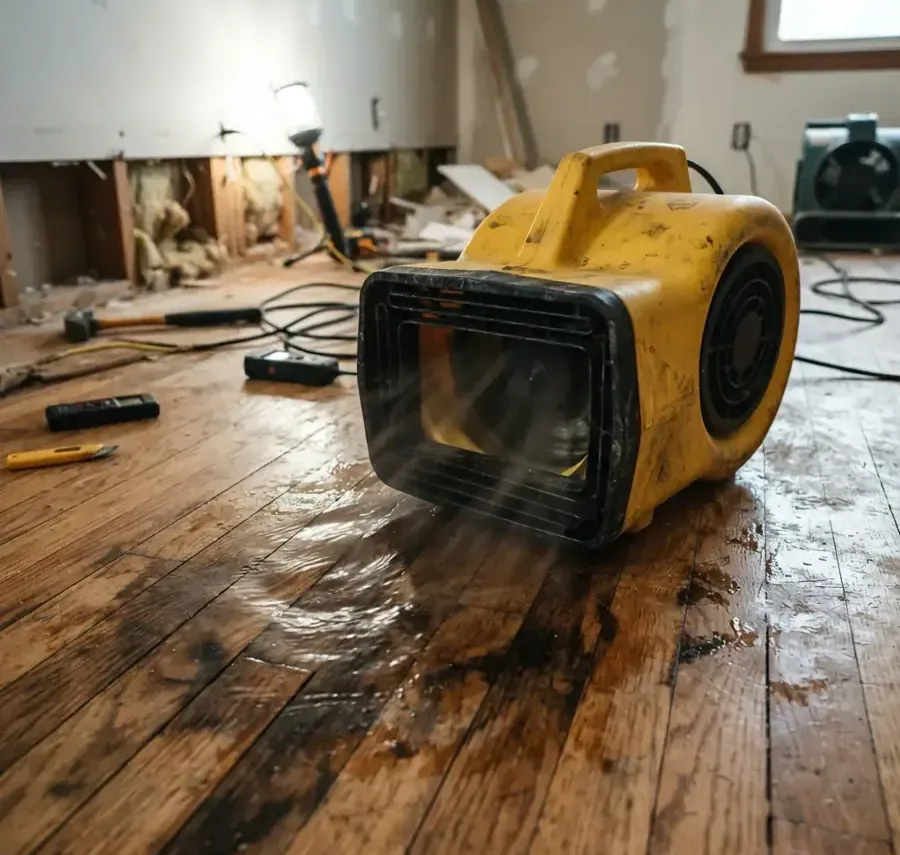
First moves when structural drying starts
- Keep the doors closed
Closed rooms let the dehumidifiers work on a sealed volume of air.
- Leave the equipment alone
Do not move or unplug the machines, since each is placed from readings.
- Skip the box fans
Household fans push humid air into dry rooms and spread the moisture.
- Keep a log
Note the date the water started and any equipment noise or power problems.
How the crew handles structural drying
Set the equipment
Air movers and dehumidifiers are placed from the moisture map, with ports and mats added for wall cavities and hard floors.
Control the room
Doors stay closed and the air is held at a drying condition that keeps moisture moving out of the materials.
Read every day
Temperature, humidity and moisture content are recorded, and units are moved as the wettest spots change.
Release on proof
Equipment leaves only when the readings match the dry standard, and the logs go to the homeowner and the adjuster.
What does structural drying cost in Villa Park, CA?
Structural drying costs $1,000 to $2,500 for Class 1 to 2 in one area, $2,500 to $5,000 for Class 3 across several rooms, and $5,000 to $8,000 or more for Class 4 dense materials.
Class 1 to 2, one area
- Air movers set
- LGR dehumidifier
- Daily readings
Class 3, several rooms
- Wall and ceiling drying
- Cavity injection
- Psychrometric logs
Class 4, dense materials
- Desiccant dehumidifiers
- Slab and hardwood drying
- Extended monitoring
Typical ranges, not a quote. The water damage cost calculator gives a planning figure; the firm number follows the on-site moisture map.
Drying is measurement, not guesswork. Water that soaked framing, drywall and flooring does not leave on its own, and a surface can feel dry while the material behind it stays wet. About 99 percent of the city is developed with single-family homes, so each plan is written one house at a time.
How the equipment works
Air movers push dry air across wet surfaces, and LGR dehumidifiers remove the moisture the air collects. Desiccant units help with dense materials such as slabs and hardwood.
Wall cavities get injection ports that push dry air behind the drywall, and floors get mats that pull water upward from the subfloor.
Drying classes
The class describes how much water the materials hold and how quickly they release it, which sets how much equipment the job needs.
- Class 1 or 2: small areas and low-absorbing materials
- Class 3: ceilings and walls wet from above
- Class 4: dense materials such as slab and hardwood
Monitoring until dry
The team returns each day, records temperature, humidity and moisture content, and adjusts the equipment. Nothing leaves until the materials match the dry standard. A dry reference reading from an unaffected room sets the target, so each house is measured against itself and not a generic chart.
The structural drying service details describe the process, and water extraction comes first when water is standing.
The structural drying process, start to finish
- 1
Map and plan
Meters and thermal images set the equipment layout.
- 2
Run the equipment
Air movers and dehumidifiers start on the wet areas.
- 3
Monitor each day
Readings steer any change in placement.
- 4
Confirm dry
Materials reach target and the equipment is removed.
Structural Drying and Dehumidification across Villa Park and nearby towns
Drying service runs across ZIP code 92861, for detached houses near The Orchards, Santiago Boulevard and Wanda Road, and for commercial suites in the Town Center, wherever water has soaked framing or flooring.
The same service nearby: structural drying and dehumidification in Brea, Placentia, Yorba Linda.
Water damage restoration in Villa Park Every area coveredStructural Drying and Dehumidification questions
Why does drying take several days?
Wood, concrete and drywall release moisture slowly, so equipment has to keep running until the readings reach target, not just until the surface feels dry.
Can fans alone dry a wet house?
No. Fans move air, but dehumidifiers remove the moisture, and without them the humidity stays high and can keep materials wet.
Why are the machines so loud?
Air movers and dehumidifiers run all day to move air and pull moisture, which is how the drying finishes in days and not weeks.
Does the equipment raise the power bill?
It adds some use while it runs, and the drying records can be shared with the insurance company when the claim is reviewed.
What does Class 4 mean?
It describes dense materials such as concrete slab and hardwood that absorb little but hold water for a long time, so desiccant drying is used.
How do I know when the job is done?
The team compares readings against a dry reference in the same home, and the equipment leaves when they match.
Finish the job with proper drying
Moisture left in framing and flooring keeps causing damage after the water is gone. The drying team can plan the equipment, set it and prove the result with readings.